Oral health prevention doesn’t end with a professional cleaning. An important part of a dental hygienist’s job is to help patients understand what happens in their mouths throughout the day and to turn the guidance they receive into habits they can maintain over time.
Factors to consider include diet, meal and snack frequency, consumption of sugary or acidic beverages, saliva characteristics, fluoride exposure, the presence of biofilm, and oral hygiene habits.
In this context, salivary pH and changes in oral pH are two important factors in the overall assessment of the risk of caries and erosion, although they cannot be considered in isolation. Caries, in fact, is a multifactorial disease, and individual risk stems from the interaction of numerous biological and behavioral factors.
Why pH and Saliva Are Important to Dental Hygienists
Throughout the day, the oral environment undergoes constant changes.
After the consumption of fermentable carbohydrates, the microorganisms present in the biofilm can metabolize sugars and produce acids, causing a local decrease in pH. Saliva then helps restore the balance through dilution, clearance, and buffering capacity.
However, this phenomenon should not be interpreted simply as an alternation between a generic “acidic pH” and a “neutral pH.” What occurs at the level of the biofilm and at the interface between plaque and the tooth surface is more complex and also depends on the frequency of exposure, the composition of the biofilm, the availability of minerals, and the individual characteristics of saliva.
Even foods and beverages that are already acidic can cause a decrease in oral pH, but through a different mechanism—one that is direct and not mediated by bacterial metabolism—which is more significant in terms of erosive processes.
It is therefore important for dental hygienists not only to ask patients what they eat, but also how often they eat or drink throughout the day.
The Protective Role of Saliva
Saliva is one of the oral cavity’s main natural defense mechanisms.
In addition to lubricating tissues, it helps dilute and remove sugars and acids, contains buffering systems—including the bicarbonate system—and is a source of calcium, phosphate, and other components involved in maintaining the balance between demineralization and remineralization.
It also contributes to the formation of the acquired film, which acts as an additional barrier against acid attacks.
The literature also attributes a particularly important role to saliva in protecting against dental erosion: acid neutralization and clearance, buffering capacity, film formation, and the availability of mineral substrates all contribute to limiting the effects of acid exposure on tooth surfaces.
Its role must therefore be evaluated as a whole: a single salivary pH value is not sufficient, on its own, to determine a patient’s risk of tooth decay.
What Happens After You Eat Sugars and Carbohydrates
The frequency of exposure to fermentable carbohydrates plays an important role in preventive management.
After they are ingested, the production of acids by the biofilm can cause a temporary decrease in pH. Saliva intervenes through its own regulatory mechanisms, gradually helping to neutralize the acids and restore normal conditions in the oral environment.
If these episodes occur frequently throughout the day—for example, with constant snacking, sipping sugary drinks over long periods, or frequently eating between meals—the number of acid-producing exposures increases.
It is therefore helpful to shift the focus of counseling from “How much sugar do you consume?” to “How many times a day do you expose your teeth to sugar and acids?”
It may seem like a small change, but it can help patients better understand the connection between their daily habits and their oral health.
Tooth Decay and Tooth Erosion: Why They Are Not the Same Thing
Tooth decay and erosion can both lead to mineral loss in dental tissues, but they involve different mechanisms.
In dental caries, acidification is linked to the metabolic activity of the biofilm in the presence of fermentable carbohydrates.
Dental erosion, on the other hand, is a chemical loss of hard tissues caused by acids that are not of bacterial origin. These acids can be extrinsic, such as those found in certain foods and beverages, or intrinsic, such as in cases of frequent exposure to gastric acids.
This distinction is also important during counseling: a patient who consumes large amounts of soft drinks, fruit juices, or sports drinks faces different challenges than a patient who is frequently exposed to acids produced by biofilm, although multiple risk factors can, of course, coexist.
What Can a Dental Hygienist Ask About During the Medical History Interview?
The professional hygiene appointment is an ideal opportunity to identify behaviors that patients often do not associate with their oral health.
It may be helpful to explore the following topics, for example:
- frequency of meals, snacks, and drinks throughout the day;
- regular consumption of sugary drinks, carbonated beverages, energy drinks, or particularly acidic foods;
- the habit of sipping beverages for extended periods of time;
- any recurring sensation of a dry mouth;
- medications or conditions reported by the patient that may affect salivation;
- frequent episodes of acid reflux or regurgitation;
- the presence of orthodontic appliances or other conditions that make oral hygiene more difficult;
- a real opportunity to brush your teeth and use toothpaste after meals while at work, at school, or on the go.
The goal is not to impose a long list of restrictions, but to work with the patient to identify which habits have the greatest impact and which ones can realistically be changed.
Prevention Between Sessions
One of the most challenging aspects of preventive care is adherence.
A patient may be fully aware of the proper oral hygiene techniques, but everyday life presents situations in which it is not always possible to put them into practice immediately: eating out, work, school, travel, sports, or simply having a snack during the day.
That is why the role of the dental hygienist is not limited to the appointment itself, but also includes developing a personalized and sustainable at-home oral care routine.
In addition to brushing with fluoride toothpaste, interdental hygiene, monitoring the frequency of exposure, and regular professional checkups, complementary tools may be considered based on the individual patient’s characteristics.
Cariex® and Salivary pH: What the Research Says
A study on Cariex®, published in the *Journal of Clinical Dentistry*, focused specifically on the relationship between carbohydrate intake and salivary pH.
The study by Abbate, Levrini, and Caria involved 50 healthy adults. After rinsing with a 10% glucose solution, salivary pH was monitored for 40 minutes. In a second session, the same procedure was repeated, adding three sprays of the Cariex® mucoadhesive spray, which is based on sodium bicarbonate and xylitol.
Without the spray, a significant decrease in pH was observed after the glucose rinse. With the application of Cariex®, the duration of pH values below 6 was significantly reduced, and a gradual increase in salivary pH was recorded during the 40-minute observation period.
The authors conclude that, under the experimental conditions of the study, the application of the bicarbonate-containing spray was able to counteract the decrease in salivary pH resulting from exposure to glucose.
However, for a proper professional interpretation, it is important to clarify one point: the study evaluates the effect on salivary pH; it does not directly demonstrate a reduction in the incidence of dental caries or erosion over the long term.
This is an important distinction when translating scientific evidence into everyday practice.
How to Incorporate Cariex® into the Patient's Routine
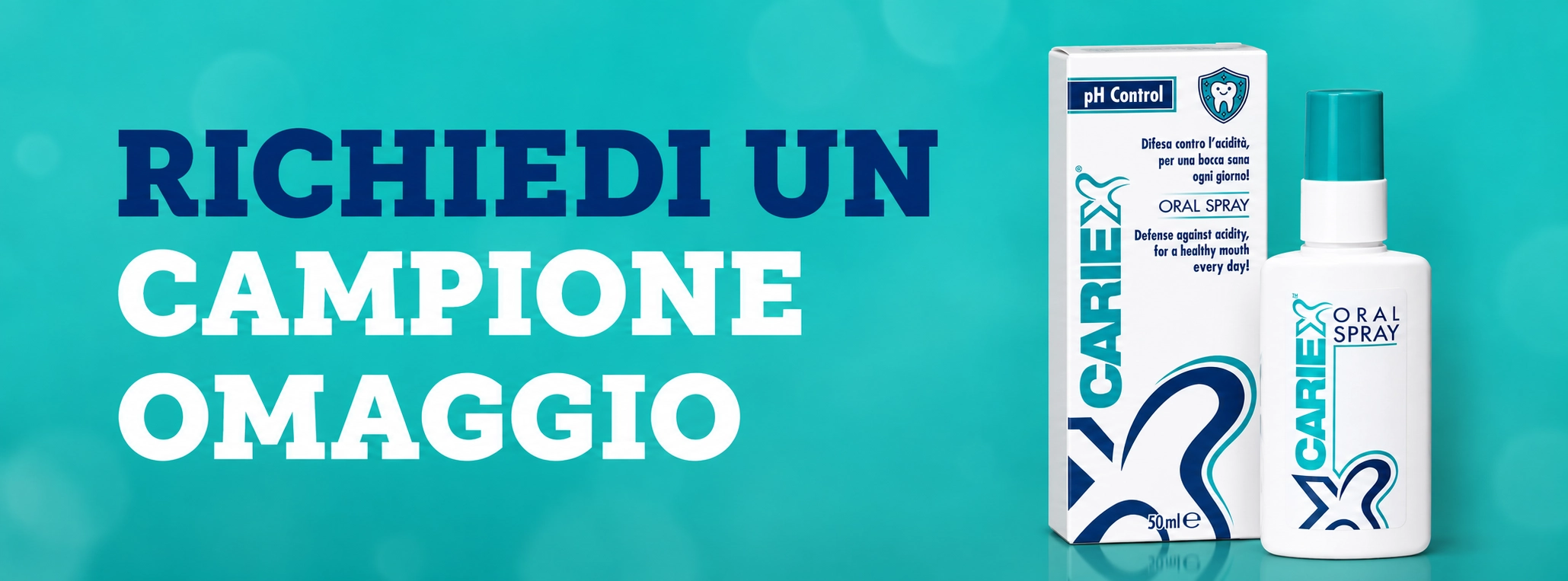
Cariex® is a mucoadhesive oral spray whose current formulation contains bicarbonate, xylitol, and hyaluronic acid. The product is designed to help restore oral pH balance and can be incorporated into your regular daily routine.
Of course, it is not a substitute for a toothbrush, toothpaste, interdental hygiene, or the instructions of your dentist or dental hygienist.
Instead, it can serve as a complementary tool to be considered, especially at times of the day when the patient is exposed to food or beverages and cannot immediately perform normal oral hygiene.
And this is precisely where the professional’s role becomes central: not simply recommending a product, but incorporating it—when appropriate—into a preventive program that is consistent with the patient’s risk profile and actual habits.
From Knowledge to Everyday Prevention
Saliva, biofilm, diet, and frequency of exposure continuously interact to shape the oral environment.
For the dental hygienist, understanding these dynamics means being able to transform the medical history interview and the professional appointment into an opportunity for more personalized education.
The most effective prevention is, in fact, that which continues even outside the dental office, through behaviors that the patient understands, accepts, and is truly able to integrate into their daily life.
References
Abbate GM, Levrini L, Caria MP. “Salivary pH after a glucose rinse: effect of a new mucoadhesive spray (Cariex) based on sodium bicarbonate and xylitol.” J Clin Dent. 2014;25(4):71-75. PMID: 26054182.
Dipalma G, et al. “Dental erosion and the role of saliva: a systematic review.” Eur Rev Med Pharmacol Sci. 2023;27(21):10651-10660. PMID: 37975390.
Buzalaf MAR, Hannas AR, Kato MT. “Saliva and Dental Erosion.” J Appl Oral Sci. 2012;20(5):493-502. PMID: 23138733.
Gao X, Jiang S, Koh D, Hsu CYS. “Salivary biomarkers for dental caries.” Periodontol 2000. 2016;70(1):128-141. PMID: 26662487.