When your mouth stays dry for several hours, taking a sip of water can provide relief, but it isn’t always enough.
In cases of xerostomia or reduced saliva production, specific products called saliva substitutes— often referred to as “artificial saliva”—can be used.
Their goal is not to perfectly replicate natural saliva—a highly complex biological fluid—but to keep the mucous membranes moist and lubricated and to improve oral comfort.
First of all: xerostomia and hyposalivation are not the same thing
Xerostomia is the subjective sensation of having a dry mouth.
Hyposalivation, on the other hand, refers to a measurable reduction in the amount of saliva produced.
The two conditions may occur together, but they do not necessarily coincide.
Dry mouth may be associated with, among other causes:
- certain medications;
- Sjögren’s syndrome;
- radiation therapy of the head and neck region;
- certain systemic conditions;
- dehydration;
- mouth breathing.
When a problem persists, it is therefore important to identify its cause, rather than simply masking the symptom.
To learn more about the causes, symptoms, and differences between xerostomia and hyposalivation , you can read our comprehensive guide on xerostomia and dry mouth →.
Why is saliva so important?
Saliva isn’t just for “moistening” the mouth.
It helps:
- lubricate the mucous membranes;
- to facilitate chewing, swallowing, and speech;
- enhance the perception of flavors;
- dilute and remove food residue and sugars;
- neutralize acids using their own buffer systems;
- to provide calcium and phosphate, which are involved in the mineral balance of teeth;
- contribute to the oral cavity’s natural defenses.
For this reason, a significant reduction in salivary function can affect not only comfort but also oral health over time.
What are saliva substitutes?
Saliva substitutes are products formulated to moisten and lubricate the mucous membranes when natural saliva is insufficient or when the sensation of dryness is particularly bothersome.
They may be available in the following forms:
- spray;
- gel;
- solutions or rinses;
- lozenges or other products specifically designed for dry mouth.
So-called “artificial saliva” is therefore not real saliva and cannot replace all of its biological functions.
Its main purpose is to provide symptomatic relief by temporarily increasing moisture and lubrication in the mouth.
In fact, the most recent reviews indicate that many saliva substitutes act primarily as humectants or lubricants, with an effect that is generally temporary and varies greatly from person to person.
Saliva substitutes and stimulants: What's the difference?
It is helpful to distinguish between two categories.
Saliva substitutes
They act directly on the mucous membranes, providing hydration and lubrication.
They do not necessarily require that the salivary glands still be able to produce significant amounts of saliva.
Saliva Stimulants
Instead, they aim to increase the production of natural saliva and are therefore most effective when the salivary glands still have some function.
Simply chewing sugar-free gum, for example, can mechanically stimulate saliva production in some people.
There are also specific medications that stimulate the salivary glands, but they must be prescribed and evaluated by a doctor because they can have side effects and are not suitable for everyone.
The choice therefore also depends on how much residual salivary function is present and on the cause of the dryness.
When saliva production is still functioning well, certain daily strategies can also be helpful: Find out which remedies for dry mouth can really help.
How are they formulated?
There is no single formulation that applies to all saliva substitutes.
Many products contain substances that increase viscosity, adhesion to mucous membranes, and the duration of lubrication, such as cellulose derivatives, gums, mucins, or other polymers.
They may also contain humectants and ingredients used in oral care products.
The formulation is important because natural saliva has highly sophisticated lubricating properties that are not easy to replicate.
In fact, some laboratory studies have observed significant differences among various saliva substitutes in their ability to adhere to surfaces and reduce friction.
That’s why there isn’t necessarily one product that’s best for everyone: comfort, durability, taste, texture, and ease of use can all greatly influence individual preferences.
How long does the effect last?
One of the main limitations of saliva substitutes is that the relief they provide is generally temporary.
For this reason, they can be used several times throughout the day, depending on your needs and the product’s specific instructions.
The following may be particularly useful:
- before and during meals, when dry mouth makes it difficult to chew or swallow;
- during lengthy conversations;
- before going to bed;
- during the night;
- upon waking;
- during times when the sensation of a dry mouth is most intense.
Those who experience this problem mainly at night can also learn more about the topic of dry mouth at night →.
Are saliva substitutes and water the same thing?
No.
Drinking water regularly is important and can provide immediate relief, especially when dehydration is also present.
However, a saliva substitute is formulated to remain in contact with the mucous membranes for a longer period and improve their lubrication, whereas water is quickly eliminated from the mouth.
This does not mean that a saliva substitute should replace hydration: the two serve different purposes.
Pay Attention to the pH of the Products
People with reduced saliva production may be more vulnerable to tooth decay and dental erosion because some of saliva’s clearance, buffering capacity, and protective functions are compromised.
For this reason, especially when natural teeth are present, it is important to avoid frequent use of highly acidic products without a specific medical indication.
Even some products designed to stimulate saliva production through very acidic flavors may require caution if used repeatedly.
A dental professional can help you choose the most appropriate solution based on the condition of your mouth and your individual risk.
What about oral hygiene?
A saliva substitute is not a substitute for oral hygiene.
In cases of xerostomia or hyposalivation, it becomes even more important:
- Brush your teeth thoroughly with fluoride toothpaste;
- clean between your teeth;
- limit very frequent consumption of sugar;
- keep any dentures properly clean;
- Have regular dental checkups.
The dentist or dental hygienist can also recommend specific preventive strategies when the risk of tooth decay is high.
Cariex® as a saliva substitute
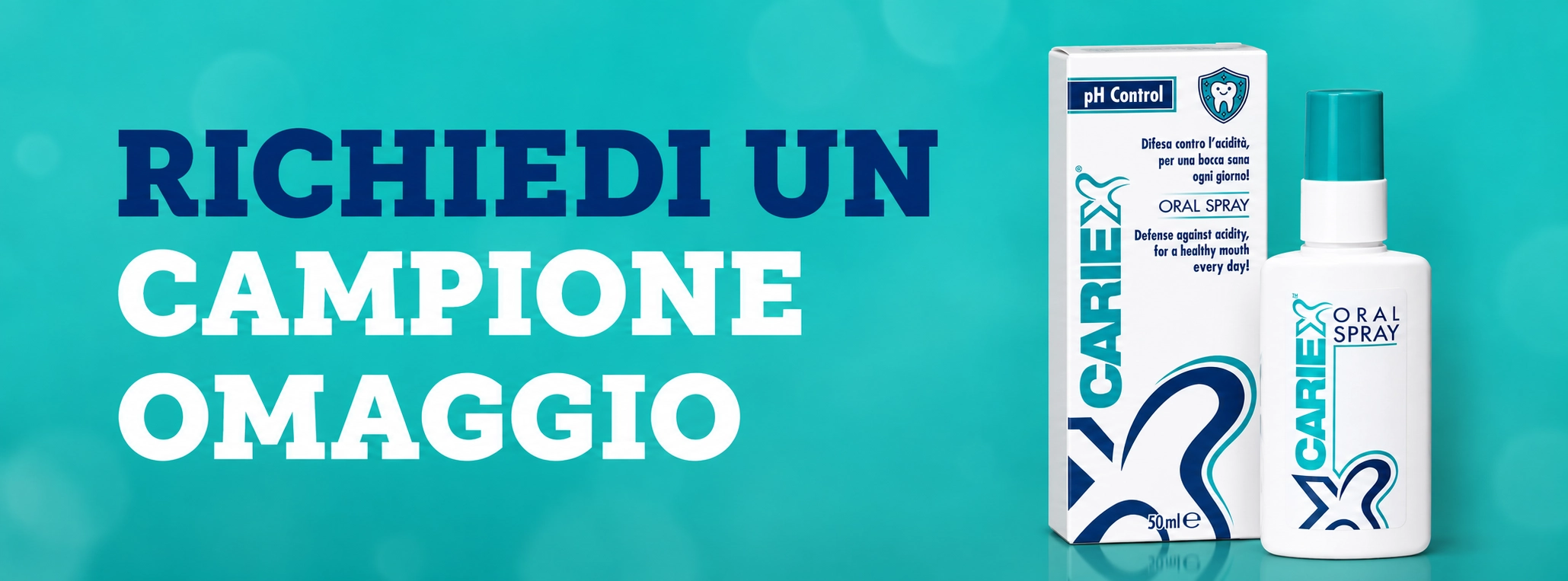
Cariex® is a CE-marked medical device in the form of a mucoadhesive spray containing sodium bicarbonate, xylitol, and hyaluronic acid, intended for use as a saliva substitute in cases of xerostomia.
The mucoadhesive formulation is designed to spread over the mucous membranes, while the baking soda helps restore the oral pH balance.
The spray format allows you to use it throughout the day and whenever you start to feel dry—just 3 sprays are all it takes.
Cariex® has also been studied in patients with Sjögren’s syndrome, a condition frequently characterized by xerostomia and hyposalivation.
In an exploratory clinical study conducted at the University of Turin’s Dental School involving 24 patients, salivary flow improved in the groups using Cariex®, either alone or in combination with non-surgical periodontal therapy, with a statistically significant difference observed in these groups.
However, the authors themselves emphasize the need for larger randomized controlled trials to confirm the results.
Cariex® can therefore be incorporated into the daily management of dry mouth, without replacing the identification and treatment of any underlying cause.
Which saliva substitute should you choose?
There is no one-size-fits-all answer.
When making your choice, it may be helpful to consider:
- severity and duration of dryness;
- the presence or absence of residual saliva;
- the time of day when the symptoms are most severe;
- the need to use the product during meals or at night;
- presence of natural teeth or dentures;
- preferred texture and flavor;
- practicality of the format;
- General conditions of the oral cavity.
Sprays and products that are easy to carry can be particularly convenient during the day, while some people prefer thicker formulations at night.
The individual response remains important precisely because the available evidence does not identify a single saliva substitute that is clearly superior to all the others.
When is it important to consult a professional?
A product for dry mouth can improve comfort, but persistent xerostomia always warrants attention.
You should talk to your doctor, dentist, or dental hygienist when:
- The dryness has lasted for several weeks;
- makes it difficult to eat, speak, or swallow;
- occurs after starting a new medication;
- an increase in cavities or gum problems;
- there is a burning sensation, pain, or recurrent oral infections;
- A dry mouth is accompanied by marked dryness of the eyes;
- The disorder interferes with sleep or quality of life.
If a medication is suspected to be the cause, treatment should not be discontinued on your own.
Saliva substitutes can be a real help in everyday life, but the first step is always to understand why the mouth is dry and what type of treatment is best suited to each individual.
Cariex® — A daily routine to protect the balance of your smile.
Buy it at a pharmacy or online
References
Conte DB, Marquezzan ME, Schneider LR, et al. “Systematic Reviews on the Management of Xerostomia and Hyposalivation—An Umbrella Review.” Gerodontology. 2025;42(2):165–176. PMID: 39838537.
Assery MKA. “Efficacy of Artificial Salivary Substitutes in the Treatment of Xerostomia: A Systematic Review.” J Pharm Bioallied Sci. 2019;11(Suppl 1):S1–S12. PMID: 30923424.
Mungia R, Cano SM, Johnson DA, et al. “Efficacy of saliva substitutes and stimulants in the treatment of dry mouth.” Spec Care Dentist. 2019. PMID: 30811076.
Gambino A, Broccoletti R, Cafaro A, Cabras M, Carcieri P, Arduino PG. “Impact of a sodium carbonate spray combined with professional oral hygiene procedures in patients with Sjögren’s syndrome: an exploratory study.” Gerodontology. 2017;34(2):208–214. PMID: 27813150.